
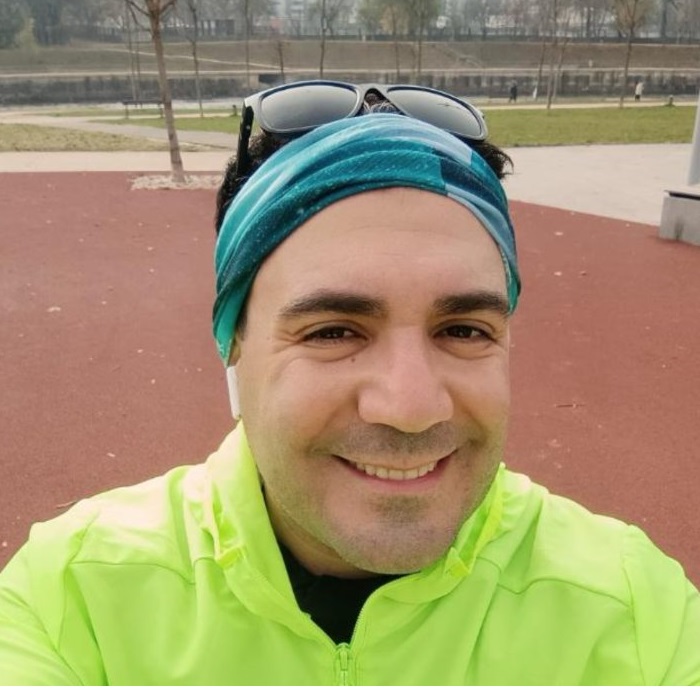
Dr. Zaher Alajlani, Ph.D., is a Syrian fiction author, researcher, and translator based in Cluj-Napoca, Romania, and Athens, Greece. He is the author of five short story collections in English and one in Arabic. His fiction and essays have appeared in numerous international journals and anthologies and received critical attention.
His stories, “Saint Catalina” and “Veorica,” were nominated for the Pushcart Prize.
Zaher also contributed to No More Haunted Dolls, a collaborative volume that critically examines horror tropes in literature, film, and video games. The book was nominated for the Bram Stoker Award for Superior Achievement in Long Non-Fiction.
He holds a BA in English Literature and Language from Damascus University; an MA in English Culture, Literature, and Ideology from the National and Kapodistrian University of Athens; an MA in Communication from the University of Indianapolis; and a Ph.D. in Literature from Babeș-Bolyai University of Cluj-Napoca.
His research interests include morality, religion, meaning, mad science, Jungian archetypes, and early modern horror literature. Zaher speaks English, Arabic, Romanian, and Greek.
Zaher enjoys running and playing video games.
- Where are you from?
I was born in Damascus, Syria, and lived there for half of my life. The other half was spent in Athens, Greece, and Cluj-Napoca, Romania.
- Why do you write?
Writing is the only way I can make sense of the human condition and the bitter irony of existence. Fiction allows me to explore truth through imagination. Being from a war-torn country and having experienced discrimination, I can only understand my trauma by exploring my characters’ trauma. My primary interest is how our sense of meaning and self-worth can survive the chaos of war, moral failure, national hypocrisy, and eventually death itself—our own and our loved ones’. Thinking of new characters and stories saved my life during some of my darkest days.
- What do you write about?
My stories often explore loneliness, estrangement, guilt, anxiety, morality, faith, nihilism, madness, and death. In my realist stories, my characters are usually flawed and in a constant existential crisis. Their tragedy is their mundane existence, and to a degree, I think this is our collective tragedy. For example, the protagonist of “Memory Eternal,” the namesake story of my latest short story collection, Mitsos, is the quintessential unnoticed tragic hero. In my horror stories, I focus on madness, obsession, innate human evil, addiction, and the uncharted territory of psychosis.
- Do you have a specific writing style?
As you can see in many of my stories, I try to be as restrained as possible, giving readers enough details to ground them in the reading experience while letting them be active participants in my fiction.
- What are the obstacles that come in the way of writing?
I think most writers would say consistency, and I tend to agree. Maintaining a steady writing habit and meeting the daily word count you set for yourself can be very challenging. The most important thing is to keep going whether you’re inspired to write or not.
- What’s the most memorable thing asked/said by a reader about your work?
At the book signing event of my previous book, Now She Dreams of War and Other Stories from Transylvania, a Romanian writer and philosopher that I deeply respect asked me, “Since I know you very well, and I know how polite and kind you are, I’m wondering how could you write some violent or dark fiction that leaves the reader feeling unsettled?” She was referring to “Necrosis,” a story from the revised edition of my first book, In Death Veritas and Other Stories. I didn’t know how to answer back then, and I still don’t know. However, that question still haunts me.
- How long have you been writing?
I’ve been writing since I was a child. My late father, may his memory be eternal, was a poet and a historian. He encouraged me to write as a child, and I’ve never stopped since. But if you’re asking about my writing career, I’d say 2012 was the year I began publishing and saw enough interest in my writing to encourage me to continue.
- What is your work schedule like when you are writing?
I have a child and a wife that I adore to death, and I have a day job. I also run almost daily. So, most of my writing is done whenever I have time, and mostly on my phone. When the work is done, I edit it on my laptop and get it ready for beta reading, copyediting, and publication. When my toddler has his nap is my favorite time to write. I wrote and published most of the short stories of my book Now She Dreams of War when my son was an infant sleeping in my arms.
- What would you say is your interesting writing quirk?
I listen to soundtracks from my favorite video games when writing.
- How long does it take to write a book? (if you’ve written one -published or non)
I have published six short story collections (only the first one was self-published) and many individual short stories in literary journals in the United States, United Kingdom, Romania, India, the Philippines, Iraq, and Tunisia. My latest collection was published on July 13, 2026, by Celestium Publishing in Oradea, Romania. I have a novella titled The Confession of Vasilis Mavriou that will be published this September by Ramina Books in the UK. I can’t really tell how long it takes to write a book. It depends. Each book is different.
- Do you have suggestions on how to become a better writer?
Stay humble and read as much as you can, especially in your genre. And of course, try to keep a consistent writing schedule. You may slip here and there, but making it a habit is very important.
- What do you think makes a good story?
Above all, fiction must be entertaining. If a story fails to entertain the reader, then something must be wrong, and the philosophical or moral depth of the story at this point is irrelevant.
- What does your family think of your writing?
My family is very supportive. My son, wife, sister, mother, and late father have always stood by my side. My wife and sister are usually my first beta-readers.
- Do you see writing as a career?
I never thought of writing as a career, but rather as something I must do regardless of the income. It’s a survival mechanism, akin to a spiritual protest against the material world and harsh existence.

