It’s a priceless feeling to get special attention from readers and other authors. Knowing this, IBP has decided to publicize authors under the author spotlight category. Check out who the ‘author of the week’ is, connect with them and enhance your marketing strategies.
I love Occult-lore and Science Fiction, but I wanted that to be the backdrop in a natural setting. So, I introduce the audience to two poor teenagers who have rough family lives, while coping with the tragic death of their best friend set in 1984. Their séance goes wrong, and they seek out further spiritual guidance, while they search for a mysterious pendant, that is rumored to have healing properties. As the story developed, Jake and Clarence kind of took off on their own, and their dialog and reactions grew dramatically as the story progressed. Plus, it is fun to write about seances in graveyards, tasseography, and portals to the astral world, also it was fun to explore on my made-up sci-fi word, that I am coining in this interview, Metageometroncalchemaltransmission. My next book, the prequel to The Evil Within the House will dive further into interdimensional travel.
I threw the kitchen sink at the audience with this one. In short, if you like coming-of-age movies like Stand by Me and have a love for the X-Files, then The Evil Within the House should be right up your alley.
I have always written, and wanted to publish, it has just taken focus and dedication to create something that I am content with. Self-publishing makes it a lot easier for any author to get started. Especially with Amazon’s print on demand. I was surprised how well physical copies have sold versus e-book’s.
*What motivates you to write?
I read a lot of horror novels, particularly paperbacks from the 1980’s. They were known as spin-rack paperbacks, put out by a company called Zebra. They have been tagged as paperbacks from hell, the artwork is flashy, and the writing is more daring than mainstream horror.
*How do you write?
Most of my ideas develop when I go for a long run. Usually, I email myself notes through out the day and form an outline at night. When I wrote The Evil Within the House, I had constructed the dialog for each scene while I was away from my computer. For me, it is easier to work on dialog as if a movie is playing out in my head. By the time I write the dialog, the clunky parts are figured out.
*How much sleep do you get during the process?
In the few weeks leading up to publishing, I got very little sleep. I received good criticism from my beta-readers and applied most of their suggestions, since the book has a few time jumps. The week before publishing, I read and re-read the book multiple times, via Text to Speech, I think I got 12 hours of sleep in three days, right before I hit print.
*If you could have a dinner party and invite anyone dead or alive, who would you ask?
Kurt Vonnegut and Quentin Tarantino You can follow me on Twitter @ThomasMichaelT9
Susan Jagannath successfully combined a passion for reading, a love of writing and a fascination for technology, to create a career in technical writing. With over 50 technical manuals (not) to her name, “RTFM” could have been the motto for her life; but she didn’t let the idea that no one ever reads the manual stop her from thoroughly enjoying her work.
As an army brat, her childhood included seven different schools, three universities and a couple of emergency evacuations from conflict zones. Travel and adventure were a normal part of life. She now believes in seizing every opportunity to have a new adventure. Whether it’s camping on the beach in Australia, trekking in the Himalayas, kayaking in Queensland, whitewater rafting down the Ganges, or walking the Camino in Spain, her philosophy is to pack it into one or two weeks to create memories for a lifetime, (and disconnect from television and computer games).
Susan is now on the next adventure of her life, traveling, writing travel books, and planning her next book.
Two Himalayan books are on 99c deal for Diwali
Describe yourself in five words
Adventurous, Risk-taking, Loyal, Funny and Innovative
What fact about yourself would really surprise people?
I’m a grandmother who hikes, loves travel and has adventures
How do you work through self-doubts and fear?
I walk them off in long hikes in nature
What scares you the most?
Dying without making a difference to the world
What makes you happiest?
Completing a book and seeing readers read it and comment.
Why do you write?
Because I must – it’s an addiction
Have you always enjoyed writing?
Absolutely – for as long as I could read, I also wrote
What motivates you to write?
Sharing my adventures, hikes and learnings with those who maybe think they are too old, too weak, too <insert excuse here>
What writing are you most proud of?
The Valley of Flowers – the book about the hike in the Himalayas, and it was especially wonderful to hike it with friends.
What are you most proud of in your personal life?
A bit astonished that I am a completely doting grandmother!
What books did you love growing up?
Enid Blyton, Narnia and Amar Chitra Katha – the latter are a comic book series about Indian mythology.
What do you hope your obituary will say about you?
She loved a lot, family, friends and adventures
Location and life experiences can really influence writing, tell us where you grew up and where you now live?
I grew up all over India in various army bases, I now live in Australia.
How did you develop your writing?
I was a technical writer for top IT and computer application firms..I wrote manuals, online help, websites and so on for over thirty years
What is hardest – getting published, writing or marketing?
Marketing
What marketing works for you?
A mixture of organic and paid
Do you find it hard to share your work?
No, not at all
Is your family supportive? Do your friends support you?
yes, I am blessed with a supportive family and friends
Dearest Reader, I’ve been practicing the Law of Attraction since childhood. I started by finding the first star in the sky and reciting a popular nursery rhyme. It goes:
Star Light, Star Bright,
First star I see tonight,
Wish I may, wish I might,
Have the wish I wish tonight.
Then I would make my wish with all my heart. I believe I received everything I wished for and truly wanted. Being a child, I forgot about my wish during the day, not realizing at the time it was the “letting go” part of the process.
When I became an adult, I stopped making wishes and reciting the poem, but I continued to get almost everything I wanted and set my mind to. When I wanted a specific job, they hired me. When I wanted something physical, I earned enough to buy it myself; I bartered for it; or someone gifted it to me. After all, I had learned that wishes come true.
I wrote The Key to the Secret to share the epiphanies, or inspired thoughts, that helped me connect the dots between some of the Law of Attraction teachings. The ones I specifically struggled with in the daily chaos of life included how you transition from imagining and visualizing what you want, to “letting go” and living your life as if you have it all now. I hope it helps you find ways to “game the system” of your own mental processes in a way that’s fun and fulfilling, so you can receive everything you desire faster.
I’m literally living my ideal schedule and the life I wanted right now, and it happened much faster than I expected. Just remember to go through every step and review and recite what you have written. Feel it and live is now as closely as you can. When you can’t physically do so, use your vibrant imagination to fool yourself into living it.
1. Define your purpose
2. Decide what you will provide in exchange for success
3. Set a date for when you will achieve it
4. Have faith and confidence
5. Embrace your negative thoughts
6. Live your ideal schedule
7. Fool yourself into your passion
8. Visualize your day
9. Practice gratitude and appreciation
10. Let believe you have it already
11. Take action on inspired ideas
12. “Donate” your bills and outstanding debt
13. Place whatever you desire in your Universe shopping cart
14. Describe your ideal relationships
15. Sign a contract with the Universe
Remember The Key to the Secret and you’ll be absolutely unstoppable.
I’m so happy and grateful for you.
~ Mina
What is The Key to the Secret about?
It’s a Law of Attraction book for readers already familiar with the law of attraction and manifesting, but who may be struggling with the hardest parts of the process, especially when it comes to believing you have what you desire now, fooling yourself into living your dream life, and letting go.
Why did you write this book?
I’ve practiced the Law of Attraction off and on throughout my life. I’ve been thrilled by successes and frustrated by setbacks. When I made a personal break through recently, it seemed so simple I couldn’t believe I’d missed it, and yet those of us struggling with manifesting simply do miss it. I wanted to help you make the same, easy connections that I did, because they really work. Then things happen – fast!
Describe yourself in five words.
Happy, content, purposeful, present, and living my life’s purpose – and you can too!
However, those descriptions didn’t apply even 2 months ago. I was struggling. What I wanted most still wasn’t happening and I didn’t know why. I consumed everything I could and slowly the pieces of the puzzle came together. That’s when everything clicked for me. I had discovered the key.
I wrote The Key to the Secret to share those pieces with you so you can live your life’s purpose too. It’s part book, part workbook and designed to guide you through the stickiest parts of manifesting for your own breakthroughs. The steps are faster and easier than you think. You do need to have a very vivid imagination and you do need to take steps forward every day, but when you’re doing what you love, it’s such a joyful process. It will feel like you can breathe again.
How do you work through self-doubts and fear?
It’s impossible to block all negative thoughts and worries. If you try, they seem to get louder and stronger. Jack Canfield of Chicken Soup for the Soul says, “Cancel. Cancel. Cancel.” Rhonda Byrne of The Secret has a wonderful “welcoming exercise”, where you hug your negative thoughts and then let them go. In The Key to the Secret, it’s about identifying the negative thought and replacing it with a positive equivalent. Then you cross out the negative version and recite the positive affirmation every day from there on out. There are many exercises out there though – it’s whatever works best for you. Try them all until you find one that works!
What scares you the most?
Like everyone, failure. Not being able to support my family. Looking foolish in front of those who are important. But once I realized those fears were in my own head (no one else’s), it all dissipated.
When you reveal your purpose to those around you, you’ll be surprised at who supports you and who doesn’t. To me, it’s a weeding out process and a necessary and healthy one.
When you’re doing what you love, it’s not work. You become radiant, which benefits everyone around you. And when you see how quickly you could be living the real you and how happy you’ll be, those around you who want the best for you will love and appreciate the change in you. Those who don’t will naturally fall away. Don’t mourn their absence because you will start attracting other people who do support you.
What makes you happiest?
Acknowledging my true path. I’m not resisting it anymore. Practicing gratitude for everything I have every day, several times a day. Having the tools and energy to help others in the ways I’m able to fills me up.
I’m showing my children I’m full of joy and love what I do and demonstrating that anything is possible and I would like you to do the same for yourself, your family, and your children!
What fact about yourself would really surprise people?
I’m trilingual, but I probably couldn’t order a meal in the other 2 languages now, it’s been so long! I’ve worked in law enforcement, information technology, and business consulting, but my most enjoyable projects were all writing-based. I keep returning to writing, so I know it’s my life’s purpose. I don’t consider writing work. It just flows. I lose track of time.
Think about what your bliss is and focus on how to do more of it. Don’t worry about the money or the time right now – knowing where you’re going is the number one priority. Then take the next step and the next, and before you realize it, you’ll be there.
Where are you from?
I’m a native to the state of Colorado, in the United States. I’ve traveled the world and seen some incredible places, but this is home. It’s an extremely harsh environment. I joke that every season is trying to kill you.
What do you hope people will take away from your writing? How will your words make them feel?
I want you to know it’s not as hard as it seems at first to make things happen. But manifesting what you want does take work. Be clear about what you want. Visualize the end goal. Don’t worry about how to get from here to there. Take small steps and actions every day that are aligned with your purpose. Fire up your vivid imagination and belief system to prepare you for the opportunities that will arise. Enjoy the game of it. Be ready for miracles. It happens faster than you think.
I’ll be releasing the follow-up book to The Key to the Secret with even more advanced techniques soon. You can sign up to be notified when it comes out here: https://dl.bookfunnel.com/731k0cw4mk
James Rosenberg is a third generation attorney who has tried cases in a multitude of jurisdictions. He utilizes his experience cross examining recalcitrant witnesses as a basis for his legal thrillers. When not practicing law he hangs out with his wife, three kids and Allie the dog. –This text refers to the paperback edition.
Where are you from?
I live in Pittsburgh, Pennsylvania. I’ve worked as a lawyer for the past 30 some years. I play as an author. By writing I get to decide how each case ends, rather than letting a jury decide the result.
Why do you write?
I write for many reasons. When I first started to write is partly as a stress reducer and partly because stories started percolating in my head and they had to get out. There are not many things better than watching a story develop on paper. With each chapter I learn more about my characters, their pasts, their motivations and what evil may lurk in their hearts.
What do you write about?
My books are generally classified as Legal Thrillers, but I think they are much more than that. Each book is actually a study of character relationships. Plot is very important, but it’s how the characters’ actions affect the people they know that is at the center of the stories I write.
Do you have a specific writing style?
Like I said, my stories are very much plot driven and I find that simplicity in writing allows the plot to move forward. I am not a big fan of long descriptive passages, so I avoid them. I want to see how a character reacts to a specific situation which allows me, and the reader, to learn much more about who this character is.
What are obstacles that come in the way of writing?
My biggest obstacle to writing is time. I still work full-time as a lawyer, so I have to squeeze in my writing time when not working or playing with my family. This means I have to economical with my writing. I have to get to work and get the words down to move the story along.
What’s the most memorable thing asked/said by a reader about your work?
I think it was when a reader wrote me a letter (yes, a pen-to-paper letter not an email) saying how much he was moved by reading The Jersey. His account of his emotional journey through the book and the bond he felt with Charlie because what had been going on in his life moved me.
How long have you been writing?
I started writing late—about seven years ago. My first writing was an essay about an experience my son had in Little League and how it moved me. Once I realized how cathartic writing could be for me and how much others could get out reading what I had written, I couldn’t stop.
When did you first realize you wanted to become a writer?
When I was young I had no interest in writing. As a lawyer, I get to write a lot, but it’s a different kind of writing. Once my life settled down a bit and I was able to get some stories onto paper, I realized I never wanted it to end. This is what I’ll be doing until I can’t think anymore.
What is your work schedule like when you are writing?
When I’m writing, I am very disciplined. I allocate 20-30 minutes each day with the goal of getting 1000 words out. If I can follow that schedule, I can get a book done in four months. It always takes longer, and the editing process takes about as long as getting the first draft done, but getting a new chapter done and pushing the story towards the finish line is awesome.
What would you say is your interesting writing quirk?
I would say it’s that I don’t outline. I know in my head where a story starts and where it ends, but it’s the rest of the story that I don’t really know until it’s written. That’s why I love to get words down because I’m learning so much about the story as it comes out and get so excited when a new plot point surprises me.
How long does it take to write a book? (if you’ve written one -published or non)
If I follow my schedule, it takes almost a year to get a book finished. I have to take the time to write the story, but the multiple rounds of editing take huge amounts of additional time and energy. This doesn’t take into account marketing for my other books or getting a cover developed for the latest book.
Do you have suggestions on how to become a better writer?
The best ways to become a better writer are to read and to write. Read in your genre, but also read in other genres. Read the best writers and be mindful of how they craft a story or how they choose to portray characters or plot. But you also have to write, write, write. If you write everyday and critically evaluate your writing and style, you will improve, and your readers will notice.
What challenges do you come across when writing/creating your story?
My stories usually involve a trial. Trials are very wordy. I worry that line after line of dialogue can be challenging for the reader. I work hard to make my trial scenes realistic, but also modify reality to try and make the interactions among the participants even more involving for the reader.
What do you think makes a good story?
Conflict. This comes in many varieties. In my stories, when there is a trial, there are inherent conflicts among the participants. There are winners and losers at every trial. But to me, although trials are essential plot elements in my books, the true conflict is between the characters. Often, they want similar things and conflict ensues when only one can achieve their goals. I think this makes legal novels gripping to read.
What does your family think of your writing?
At first, I think they were a little wary. My kids were worried about being embarrassed. With success writing, I think their wariness has transformed more into pride. My first book was modeled after an experience of one of my kids. Now the others want to be the models for the next book. I’m working hard to satisfy them.
Do you see writing as a career?
Hopefully. I still practice as a lawyer, but I would love to move full time to writing. That’s also scary. I have been a lawyer for a long time and it’s a major part of my identity. Giving that up would be difficult, but I really do love to write.
Do you have anything specific you’d like to tell the readers?
Thanks for taking the time to read through this interview. Also, thanks for thinking about trying one of my books.
When did you first consider yourself a writer?
Even after I finished my first book, Legal Reserves, I couldn’t call myself an author. I felt like a fraud. But once the book started to sell and move up lists, I began to think that people actually liked what I wrote. Once I saw my books were selling in countries around the world and I received positive feedback, it helped my confidence as a writer. I find it much easier now to call myself a writer.
Aaron LA. V.R. grew up in Michigan, spending most of his childhood creating his own adventures. Inspired by popular science fiction movies, cartoons, and video games, he would often create stories he either wrote or acted out while playing with friends. As a teenager, he became interested in music and turned those childhood stories into songs. As an adult, he found his way into the world of news, working as a news producer and freelance writer. After many years of searching for the right medium to express his creativity, he is here, hoping to share his imagination and experiences with you as an author.
Where are you from?
I grew up in the United States in the state of Michigan. I’m from the west side of the state, actually, close to Lake Michigan. It’s a very pretty area and fairly quiet.
Why do you write?
Well, I write because I’m very emotional and need an infinite universe to vent my emotions, hahaha. No, but really I write because I have an overactive imagination and need an infinite universe to express my creativity. There is no limit to what you can become or create when you’re writing, no taxes, no hidden fees, no red tape, just freedom. So, I guess you could say I write so I can be free.
What do you write about?
In general, what I write about really depends on my mood for the most part. Sometimes I will write uplifting stories other times; I will write sad or mysterious ones. That type of writing is actually more connected to when I was writing songs and creating rap music, though. But what I enjoy writing about the most is science fiction! I love the action and adventure and space! It’s so awesome! When I was young, I was always intrigued by the stars and the thought of what was beyond them. I used to spend hours at the library reading astronomy books. I was also a big-time anime, manga, superhero cartoon, video game and sci-fi movie nerd, to top all of it, hahaha.
Do you have a specific writing style?
If I had to put a name to it, I would call it movie-style writing. When I’m writing, it’s almost like I’m watching a movie in my mind. I can see the scenes playing out from a to b and hear the dialogue taking place while it’s all happening. I don’t know if it is like that for everyone. People always have told me that I’m weird, so maybe that’s not normal, hahaha.
What are obstacles that come in the way of writing?
For me, it’s probably motivation. Sometimes I will sit and stare at a blank page for hours and not write a thing. It’s not that I can’t get some words on the screen or page; it’s just that I don’t feel like writing. I’m a very lazy creative sometimes. . . But When I feel like writing, I’m taking off!
What’s the most memorable thing asked/said by a reader about your work?
Someone told me that my story delivered. That was the coolest thing to hear! The main thing I’m worried about when people are reading my book is if it delivered, so that was just super awesome!
How long have you been writing?
It’s been like 15 years. I have written a lot of things that I never tried to use. I’m my own worse critic at times, I think. I had a few book ideas over the years that I just never finished because of that. I may actually revisit some of those now that I finally have something published.
When did you first realize you wanted to become a writer?
I think it was when I realized I was a storyteller. I was writing songs and news articles for years and never really considered myself a writer, even though I had been doing it for half my life. One day it just kind of dawned on me that I was doing more than just writing; I was telling stories. It was at that point that I kind of made the decision that I wanted to be an author and write novels
What is your work schedule like when you are writing?
Honestly, it’s like having two jobs. This goes back to the motivation thing I was talking about earlier. So, I work on news stories for 8 hours, then I go home and stare at a blank screen and decide if I want to write some more, hahaha. I usually fall asleep at that point! But every so often, I find the motivation to write more!
What would you say is your interesting writing quirk?
I think I have a way of drawing the reader in and making them see what they’re reading in their mind. So my movie-style writing, I guess.
How long does it take to write a book?
The first book that I recently published, “Absonbrite: Shadows in the Lighthouse” took 3.5 years. I was actually learning the process of how to write a novel while writing that one, so it took some time. Now that I have a rough idea of what I’m doing, we will see how long it will take me to write the second one.
Do you have suggestions on how to become a better writer?
I would say use the story engine method when writing. Develop your characters, backstories and the plot before you write. Having source material to draw from will help you move forward when you hit those nasty writing blocks! Look at the different styles of writing 1st person, 2nd person, etc. Also, be descriptive, learn how to use details. Readers want to be able to see, hear, and feel what your characters are going through. So describe to me what they are feeling, where they are at, and what they are learning from it all.
What challenges do you come across when writing/creating your story?
The biggest challenge was what to write about. So I knew I wanted to write a science fiction story, but I didn’t know what kind. I narrowed it down with the story engine method I mentioned before. Another thing was knowing what to write next. So you’ve got an amazing 1st chapter; how do you follow it up? The answer I found was simple, just continue to tell the story. You really have to let go of the what-ifs, and the how do I, when you’re writing and just continue to tell the story. It all comes together in the end.
What do you think makes a good story?
In general, I would have to say layers. A story with layers is going to take the reader deeper and deeper every chapter they read, all the way to the bottom of the rabbit hole. So depth is what makes a story good, in my opinion.
What does your family think of your writing?
Most of my family members haven’t read my book, hahaha. But the few who have liked it.
Do you see writing as a career?
In the long term, yes. But at the moment, I’m just an amateur. I have a lot to learn and a long way to go still.
Do you have anything specific you would like to tell the readers?
Yes, I do! When you read my book “Absonbrite: Shadows in the Lighthouse,” please leave me a review! I need to know if my writing stinks and what I need to improve on! Thanks in advance!
G. David Walker was unexpectedly born in Ulysses, Kansas on a bright, sunny morning in July of 1963, the youngest of four brothers and one sister. As the internet had not yet been invented when David was a young man, he instead devoured any science fiction or fantasy book that he could get his hands on, dreaming of different worlds, fantastical creatures and strange, alien beings. As an adult, he decided to forge into the realms he had only read about, creating his own worlds to explore.
He currently lives in southwest Missouri. For more information, visit his blog, Chasing Dragons in the Ozarks, at http://gdavidwalker.com/
Describe yourself in five words Hm, that’s not as easy a question as it looks. I don’t think about myself all that often, but I’ll give it a shot. Five words, let’s see… Homebody, analytical, casual, observer, empathetic
What fact about yourself would really surprise people? People meeting me for the first time might find it hard to believe that I once performed in a rock band in Las Vegas. Doesn’t quite fit the quiet, mildly reserved image I have now.
How do you work through self-doubts and fear? Self-doubt is definitely more crippling than fear. Basically, you just have to tell yourself that the only person you have to prove anything to in the end is yourself. I think of a line from “Facing the Giants” where a kid is afraid to try out for the football team. His father tells him, “What have you got to lose? You’re already NOT on the team.” You never have a chance to move forward until you take the first step.
What scares you the most? Other then some more common phobias, what scares me the most is letting people down who rely on me.
Why do you write? Too many ideas in my head not to. I’ve got a Word document with almost sixty pages of story ideas, scene snippets, dialogue, character ideas, and more. If I never added another word to the document, I have enough prompts to last the rest of my life. Of course, I’m always adding to it, so I’ll never run out of stories to tell.
Have you always enjoyed writing? I’ve always enjoyed the written word, whether that be reading, editing, proofreading or writing. In my younger years, I read voraciously. Then, I finally decided to start creating my own worlds for others to explore in the hopes that they would enjoy my stories as much as I enjoyed others’.
What writing are you most proud of? Anything that helps someone get away from the real world for a little while or anything that helps someone deal with problems they may be facing.
What books did you love growing up? Pretty much anything science fiction. Although I mainly write fantasy now, I grew up on sci-fi. Eventually, I’ll put some of my science fiction ideas down on paper too.
Location and life experiences can really influence writing, tell us where you grew up and where you now live? In my younger years, we moved around a lot. My adoptive father was in construction, so by the time I finished fourth grade, I was living in my ninth city in my third state (Kansas, California, Missouri). After college, I moved to Las Vegas for about six years, but now I’m back in SW Missouri.
How did you develop your writing? Write, write, and then write some more. I’ve read numerous books on the art of writing, even taken a couple of courses. But in the end, as they say, practice makes perfect, or if not perfect, at least better than before the practice.
What is hardest – getting published, writing or marketing? For me, the marketing is definitely the most challenging. As someone who prefers to stay behind the scenes, putting myself out in front of the world is a little difficult. But, as a self-published author, that just comes with the territory.
Do you find it hard to share your work? Once it’s in a state where it’s ready to be shared, not really. The hard part is getting it to where I think it’s worth sharing. Rewriting sections, fixing mistakes and typos, filling plot holes, basically going over a manuscript again and again and again until I’m satisfied it’s worth putting out there.
What else do you do, other than write? I also work as a software developer, at least until I get a movie deal, lol. I occasionally do some editing and/or proofreading for others as well.
What other jobs have you had in your life? I did the obligatory stints in grocery and fast food in high school and college, along with a summer of putting up sheet metal siding. After college, I moved to Las Vegas and worked in casinos for a six years. Then back to Missouri where I took over a family health food store for a few years. After that, I worked for a door and window manufacturer, first in the glass shop, then as a factory order writer, then a Special Projects AutoCAD draftsman, before ending up in the IT department as an RPGLE programmer.
If you could study any subject at university what would you pick? Other than writing? Probably psychology. I took a psych class my first year in college and thought it was interesting, but that wasn’t my major, so that was the only class I took on that subject.
If you could live anywhere in the world where would it be? I’m actually pretty happy where I’m at, but I would love to visit Scotland someday and have some authentic haggis in a pub.
How do you write – laptop, pen, paper, in bed, at a desk? I still use a PC for my writing. If I go somewhere on vacation, I’ll move the docs to my laptop, but at home I use the PC. I know some writers feel more connected when they write by hand. I’ve tried it (had to one year when I forgot my laptop’s power cord), but I just prefer a keyboard.
How much sleep do you need to be your best? I used to be able to function on five hours or so. Anything more than six or seven and I’d drag throughout the day. That was in my 20s and 30s. Now, I need at least seven to keep from being foggy-headed the next day.
Every writer has their own idea of what a successful career in writing is, what does success in writing look like to you? Well, beyond the obvious answers of writing full-time and being debt-free, my idea of a really successful writing career would allow me to use my income to help others in need and/or to help revitalize our small town. J. K. Rowling money would do it, right?
If you could have a dinner party and invite anyone dead or alive, who would you ask? These “who would you invite” questions are not as easy as they sound. I had to think about this for a while because there are SO many figures from history who would be fascinating to speak with. Okay, assuming the language barrier is magically removed, I’ll start with (from the past) Nikola Tesla, although he’d have to severely dumb down practically everything he might say. Then add Jules Verne, Mark Twain and Isaac Asimov. From the (currently) living, I suppose Henry Cavill, Liev Schreiber, Elizabeth Mitchell, and Bree Turner (the living are all actors I’d ask to be in the movie based on Jaben’s Rift, lol).
When you are not writing, how do you like to relax? I read, I’m guilty of a bit of binge-watching science fiction series, and PC gaming.
What do you hope people will take away from your writing? How will your words make them feel? I mainly want people to be able to get away from the world and its problems for a while. If I can make them smile or give them something (hopefully encouraging) to think about, so much the better. I just want them to enjoy their time in the worlds I create.
From an early age, Mr. Gomez has been fascinated by subjects of mythology, folklore, ancient history, and the paranormal. He always enjoyed art but never considered becoming an author. It all started as an outlet and a way to express his creativity. His passion for writing had later resulted in several published Novellas and Short Stories. Mr. Gomez admits his love for storytelling, imagery, atmosphere, and tone. He attends College pursuing a degree in English Language and Literature. He enjoys reading, riding his bike, and collecting coins from different countries in his spare time.
· Where are you from?
I was born in Venezuela but had lived in the US for more than 20 years.
· Why do you write?
It is my passion, one that I did not know I had. Writing is an outlet and a way to express my creativity. Writing allows me to connect with others at a deeper level, no matter what their race, sex, religion, or political views.
· What do you write about?
I write Short Stories and novellas in the genre of Horror, Historical Fiction, and Cyberpunk.
· Do you have a specific writing style?
Yes, I think that by being bilingual, in a way you have a writing style. I prefer the 1st Person Point of view and Am not too crazy about dialogue. I strive to stand out from other writers, we can say I add some of my own ingredients to the stories.
· What are obstacles that come in the way of writing?
The biggest obstacle is your attitude about life. I am, however, my worst critic. It is important for me that I am satisfied with the finished work. When you are passionate about what you do there are no real obstacles.
· What’s the most memorable thing asked/said by a reader about your work?
A reader, a sweet old lady, said to me after reading one of my books: “From now on Francisco, I’m calling you Mr. Scary!” I took that as a compliment of course.
· How long have you been writing?
I started writing 8 years ago and published my first short story back in 2014.
· When did you first realize you wanted to become a writer?
Good question. It all started during a very dark period in my life. The writing was pretty much all I could do. I took pen and paper and started writing, and ten books later, here I am! To be honest with you, I never considered becoming an author in my life.
· What is your work schedule like when you are writing?
Every day of the week, I prefer the early evening and nighttime. On Sundays, I like writing after a nice relaxing bike ride.
· What would you say is your interesting writing quirk?
Sometimes I do not reveal much about the protagonist or the events surrounding the characters. That forces the reader to use his/her imagination. It gives a sense of mystery to the overall theme.
· How long does it take to write a book? (if you’ve written one -published or non)
Normally, a short story or novella takes me 6-7 months.
· Do you have suggestions on how to become a better writer?
Yes, my best advice is to get started! As simple as that. Grab a pen and paper and jot down a few ideas. You have to start somewhere and go from there.
· What challenges do you come across when writing/creating your story?
Making it original. I do not want to be a copycat. I want to offer something different, what would be the point in writing things that everyone is writing about? It is important for me to make something fresh and unique.
· What do you think makes a good story?
A good story speaks to you and makes you think about it after you have finished reading it. Then again, you may get a different answer depending on what you ask. That is why I believe it is important that you never compromise your vision.
· What does your family think of your writing?
They are very supportive. My Dad, who enjoys writing as well, is always trying to help me with my books. We share a love for words and language.
· Do you see writing as a career?
I would like to do writing full-time in the future. You have to understand there is a lot of competition, and making writing a career is not easy. I believe God will set things up when the time is right.
· Do you have anything specific you’d like to tell the readers?
I am very grateful to all my readers. Your support is golden! I never take you for granted. Thank you all! Please continue supporting my work.
· When did you first consider yourself a writer?
After publishing my 8th Book that is when I considered myself a storyteller. The definition of a writer can mean different things depending on who you ask. Anyone can write, but telling a story, in my humble opinion, is a completely different thing.
Following twenty-five years of military service as a U.S. Army ranger and paratrooper, Brendan Wilson retired as a lieutenant colonel and then joined NATO where he served as a defense planner and diplomat for the next fifteen years. During the course of his forty years of work as a soldier and diplomat, he saw service in war-torn Libya, Ukraine, Kosovo, Bosnia, and Iraq. In addition, he commanded a fire base on the DMZ in the Republic of Korea.
A former coach and team captain for military martial arts competition teams in the 101st Airborne Division and the 18th Airborne Corps, he holds master ranking (8th Dan) in three different martial arts, and he won the silver medal in the 2009 U.S. Open for Taekwondo. He was one of the founding members of Aristos, a form of martial arts based on Classical Greek principles.
In retirement, Wilson turned his efforts to filmmaking. He wrote and produced two award-winning short films (“Doug’s Christmas” and “A Child Lies Here”) and served as executive producer for the award-winning web series, “Greeting! From Prison.” Moved by seeing human lives upended in war-torn areas, Wilson enrolled in law school and, as of this writing, he is in his final year. Once he qualifies as an attorney, he plans to volunteer to help refugees. Wilson lives in Sycamore, Illinois. He spends his days, writing, studying law, and practicing his martial arts.
Where are you from?
I was born in Hampton, Virginia. My father was in the Army and we moved a lot. I remember living in Alabama, Germany, and New York. When I was 14, we moved back to Virginia. That’s where I attended high school and college. After graduating from college, I entered the Army as a 2nd Lieutenant. Again, on the move a lot — North Carolina, Georgia, Kentucky, Colorado, Korea, and Belgium. After more than two decades, I retired from the Army and took a job as a defense planner and diplomat at NATO headquarters in Belgium, where I stayed for another 15 years. Three years ago, I came back to the US and have settled in Sycamore, Illinois, a small town an hour West of Chicago. I love it here, and so I would have to say, this is my home now.
Why do you write?
Although the answer to that question is probably more complicated than I could articulate, even to myself, I think I write mainly because there is a story in my mind and it wants to get out. That story is a vague image inside me, and only takes form when I put into words.
What do you write about?
During my professional career as an Army officer and later as a diplomat, I wrote mostly professional articles about tactics, defense policy, counter terrorism, and NATO. Along with that, I wrote about a dozen articles about martial arts philosophy and history. Beginning about ten years ago, I began to write for films. I wrote the background stories for Doug’s Christmas and A Child Lies Here, both of which because award-winning short films. In parallel, I wrote the draft of The Achilles Battle Fleet. Not quite sure how that got started or even if I intended it to be a novel when I first began writing it. In 2018, when it was clear I would be retiring, I set the goal of getting the novel published and I also took up the study of law, something I had started many years before. The Achilles Battle Fleet is military sci-fi, but it has a strong martial arts theme.
Do you have a specific writing style?
I do try to make sure the text is readable and interesting. I think I read once that a very accomplished author said great literature is whatever gets the reader to keep reading. Whatever message I want to communicate I need to engage the reader.
What are obstacles that come in the way of writing?
The Greek philosopher, Epictetus, a former slave, wrote that if you want to be a writer, write. I think the biggest obstacle is laziness. I just need to get in and do the writing. I wrote The Achilles Battle Fleet over about seven years, and then another few years re-writing and editing. Most of that time, I was very busy with my job at NATO. My work day started at 6 a.m. and ended often late in the evening. I also travelled a lot. Some of the book was written on my cell phone while on a train, bus or plane. Some of it was written while I was in Baghdad, in a bunker.
What do you think makes a good story?
A good story is about the people, the characters. The purpose of the action is to show how the characters react, what decisions they make, and what happens to their personalities as the plot unfolds. In The Achilles Battle Fleet, I put the characters in situations very like those faced by most people. Under stress, they have to make a decision, for which there is no perfect solution. Every potential course of action has risks and even certain negative consequences. It’s unavoidable. The key is to show that conflict, to let the characters own their decisions and to watch how those difficult decision impact their own personalities and values.
For example, Mei Ling Lee, the main protagonist, comes to the story as an accomplished martial artists and competitor. In the battles that she fights, she is forced to use her martial arts prowess. Under the pressures of the fighting, she comes to understand her own power. She sees in herself a love of the combat, and she is not sure what that says about her. Is she a good person? Does she feel remorse? And is she fully in control? But there is no time to contemplate; she has to move on to the next challenge. That’s life, and that is a similar dilemma that most readers will relate to in everyday life, whether in their jobs, their family life or their other aspirations.
Do you have anything specific you’d like to tell the readers?
I do have five words, but they require some explanation because they are not in English. I was one of the founders of a style of martial arts called Aristos. It is based on the philosophy of classical Greece. The five words represent the philosophy of Aristos. They don’t so much describe me as they describe an aspiration I have:
Arete: Excellence. You become what you diligently practice. It transforms you.
Agon: the source of the English word, agony. It means struggle. Life is a struggle. One should embrace that reality and act accordingly.
Xenia: The guest-host relationship. It is a developed idea of courtesy. Both the guest and the host have mutual, interlocking obligations to each other. It is not the type of courtesy that means submission or subservience.
Techne: Art or technique. In martial arts it is the mechanism of coordinated movement that generates power, focus and balance.
Arche: The Greek word from which we get the English word archeology. It means foundation.
So, what do those five words mean to me? That I can shape my life and myself by my own efforts and that I am responsible for the outcome. If I want to be a writer, I will need to invest the time, effort and risk that are inherent in that effort. If I choose to be a couch potato, I know how to do that too. Either way, it’s my call and my responsibility. That life is a struggle and is not fair. I shouldn’t expect it to be. I must not fret when things don’t go my way. Life is necessarily a struggle. That my relations with others are governed by my own code of duty. I have a responsibility to others to act in such a way that they are not harmed, and I should expect that level of care from others, especially those with whom I choose to share my life. And that I have a duty to assist those in need, as I have been helped by others. That skill is important, and that I need to develop, through hard work and perseverance, the techniques in my profession and in my private life.
What fact about yourself would really surprise people?
I think most people see me as a reasonably polite person of mild temperament. And I do think that is mostly correct. But I think most people are surprised if they learn that I was an Army Ranger, that I serve in places like Iraq, Libya, Ukraine, Bosnia and Korea. Or that I am an 8th degree black belt who won the silver medal in taekwondo competition at the US Open. People can be more than one thing.
How do you work through self-doubts and fear?
I think the most important thing to do is put aside the fear of failure. Ultimate success requires pushing the limits of what we are capable of, and that effort, guarantees some failure. The next most important thing is to ignore those who would like you to stop trying. They’re always out there, and sometimes they be loved ones who mean well. But they are wrong. My life is my adventure. When I was 22 years old, I wanted to go to the US Army Ranger School, well-meaning friends and colleagues shook their heads and said things like, “you have no idea what you’re doing, you’ll never make it through.” I’m glad I ignored them.
What scares you the most?
Of the things that are under my own control, I most fear that I won’t live up to my own potential. Life is a precious and temporary adventure; it deserves my best effort.
What makes you happiest?
Easily, time with my wife, Kay, which is inseparable from the joy of being alive.
What writing are you most proud of?
Good question! It’s hard to say one thing. No question, my Novel, The Achilles Battle Fleet has to be at the top of the list. I am also very proud of the writing I did for the short films, A Child Lies Here and Doug’s Christmas, both of which were award-winning films. But I do have a favorite poem. It’s titled The Warrior’s Dawn Prayer. I wrote in my darkest moment and I still read it every day. I had just been sent home from overseas, having spent a good deal of that time in Iraq. I was back in the states getting treatment for PTSD. While there, my employer terminated my employment. It was a low point. I was living in a hotel room, away from family. I had decided if I couldn’t work, that would to finish law school and complete my novel. I desperately wanted to keep moving and not give up. Here it is:
The Warrior’s Dawn Prayer
Help me lift my warrior’s heart from despair
One last battle with honor, dignity and righteousness
Bathe me in the blessing of combat
Strengthen my hand
Let me breath deep the joy of life
Give me the warrior’s delight in taking my place
In the long line of those who never give up.
What are you most proud of in your personal life?
I think my journey in the martial arts has to rank high. When I was 16, I got cut from the varsity baseball team. I went that day to a local martial arts studio and took up the study of Tae Known Do. That was 47 years ago. I’ve studied, and trained others in many places. It is a great solace to me now. My wife and I train every day at a local park. I now have an 8th Dan in three martial arts styles, and I won the silver medal at the US Open at the age of 50. It’s a great journey and it’s not over.
What else do you do, other than write?
I retired from work three years ago. Since that time, I have been finishing The Achilles Battle Fleet, attending law school and continuing training and teaching martial arts. My daily routine is to get up and share breakfast and a walk with my wife before she goes to work, then I walk to the local park, train there in martial arts, and return to the house for study, writing and the basic chores of living.
What other jobs have you had in your life?
As a 13-year-old, I worked nights and weekends as a dishwasher at a Greek diner in New York. It was a wonderful introduction to the adult world of work. As a teenager during the summers of high school and college, I worked construction, moving furniture, and pumping gas. After college I have had two jobs. I was an Army officer for 25 years and then a defense planner and diplomat for the next 15.
If you could live anywhere in the world, where would it be?
I’ve lived many places. I spent a total of 28 years living outside the United States, and through my work, I’ve traveled broadly throughout Europe, Asia and the Middle East. Right now, I am very happy to be living in Sycamore, Illinois. It is the perfect place for me, a small town, wonderful, friendly people, and not too far from larger areas, like Chicago, should I like to visit. In answer, if I could live anywhere, I’d be right where I am in Sycamore Illinois.
Tell us about your new book? Why did you write it?
The novel is about a group of military people who are caught in the eruption of a galactic-level surprise attack followed by a war against an unknown enemy with a seemingly impossible technological advantage. When their rag-tag convoy of spaceships carrying civilian refugees is attacked and disabled, many of their friends and colleagues are killed, along with almost all of the convoy’s leadership. An older rear admiral, long past his prime, takes charge of the survivors and gets them working together not just to survive, but to take the attack to the enemy. The admiral’s aide, Lieutenant Mei-Ling Lee, is thrust into a key role in the preparation for the upcoming offensive. As the conflict continues, she is forced to draw upon her martial arts skill and her inner strength as she fights alongside the fleet’s marine commando unit. In the desperate war that follows, Lee struggles with a budding romance, new friendships, and startling betrayals, to become the warrior she was meant to be.
What do you hope people will take away from your writing? How will your words make them feel?
My former boss, General Wesley Clark, who was the NATO commander in the late 1990s, was kind enough to write the forward for my novel. He wrote, “Readers will take from Brendan’s novel an understanding that individuals make a difference, that character counts, and with courage and competence, history is made.” The Achilles Battle Fleet is more than an adventure story. I believe readers will both enjoy it, and maybe it will even give them some perspective on their own adventure. Life is fantastic.
Hares Youssef is a futurist thinker, digital economics ideologist, philanthropist, writer and artist.
I was born in the province of Latakia into a very low-income family. We lived in a clay house, and we had no electricity, water, telephone, or TV. Nevertheless, I managed to visit the world in which people lived thousands of years ago, knowing nothing about modern civilization and its so-called benefits. I grew up close to nature, and the land gave my family everything. Since childhood, I considered the earth as a living being, as a Mother and a giver. The history of my native Latakia is connected with Mother because it’s named after Laodicea, the mother of its founder Seleucus I Nicator.
As I grew older, I moved out of my childhood home. First, I moved to a small town, then to the capital of Syria before moving to the Soviet Union, where I entered a military school. A symbolic story is related to this event, as I never intended to be a cadet. I wrote poetry, was full of creative inspiration, and constantly criticized the Army, military equipment, and everything connected with it. I entered the Damascus Institute of Architecture, I won a place in the contest, and I was delighted to become an architect. One day, my uncle invited me over. He held a high position as a well-known politician. He convinced me that I had to leave and study in the military school (through the Ministry of Defence). I believed him because, at that time, we both thought this educational institution also trained architects. But that was not the case. I was discouraged when I realized that I was going to the Soviet Union, and studying architecture wasn’t an option. I didn’t know what would come next.
I remember how I entered the office, either of the general or colonel, where I had to choose my future speciality. He put the list before me and awaited my decision. Each option involved moving to a particular city. I focused on those professions that were foreign to me, and I didn’t know what to do. None of my classmates had that choice, and, it seems, I should be happy with my privilege, but all I felt at the time was disappointment, frustration and shock. In response to the interrogatory look of a person who noticed my indecision, I admitted that I wanted to become an architect. He answered: “I don’t have a ‘career fair’ for you, so you have to choose among the options.” Behind that general or colonel, there was a geographic map with the flags of the USSR. After getting over the excitement, I asked permission to choose not from the list but from the map. There were names of cities, but they meant nothing to me. Finally, I pointed the finger at Kyiv. There were only three options: a tank school, an aviation school, or an anti-aircraft missile school. And I chose aviation.
When I arrived in Kyiv, I was depressed, I stopped eating and drinking, I refused to attend classes. I didn’t want to be there. I bide my time and waited to leave. That summer, I left Kyiv and told my uncle that I would never go back. But he confronted me and advised me that I could not do architecture because obligations bound me to the Ministry of Defence. My uncle wanted me to graduate, so I had to return. They transferred me from an aviation school to a tank school, where the cadets had more freedom, but it was four years before I left. I deserted from the Army, and they caught me. Then I spent three more years trying to escape and free myself from my obligations to the Ministry. My uncle’s friends, who had already left the country due to disagreements with the president, helped me.
How did the idea of creating Gaiia come to you? Where did it all start?
-In the beginning, there was no name Gaiia. There was an idea. An idea of a natural planet with a natural person in the role of a just king; a planet with the best way of life, where peace and harmony reign. This idea drove me and forced me to ask questions: what is the problem? Why – with his mind, intelligence and reason – has man failed to become the ‘father of all living things?’ The name Gaiia appeared later. In the long process of searching for the answers to these questions, the name came to me quite suddenly. And it seemed to contain all the answers at once.
I understand the role of names and terms. A title contains everything that included in its name. If the name of the Universe is the Universe, then the Universe will remain limited by this name until we find another word for it – one that embraces everything that we have not yet put into this concept. We can limit, even remove part of the essence of what we mean with a name. And with a name, we can create an entirely new world or transform the old one. As far as the name Gaiia is concerned. I don’t remember exactly when it came to me, but, of course, I had often heard of the Greek goddess Γαῖα. Its name has become a symbol of my entire philosophy.
Writing a book is one way to share your impressions, knowledge and philosophy with the world. However, I don’t intend to limit myself to the book. I’m planning to create a Movement, a platform, film, magazine, etc. The book is just the beginning. For me, the book establishes the legitimacy of what I can introduce to the world.
What did youwant to reveal to your readers?
I wanted to open my readers’ eyes to a new dimension that is above logic because I’ve discovered that, as children, we are all mentally abused. I’m talking about how teachers forced us to interact with counting and arithmetic. This violence destroys most of the human intellect. It is so harsh that it makes logic a hostage to the way we think. Even when we think, we think by counting. But reflection is not involved in this process at all. For this reason, a peaceful, harmonious, beautiful world turns into idiotic romanticism. Our entire civilisation, as it exists today, is a design project of the same counting logic.
I find it astonishing that the intellectual elite considers our civilisation an outstanding achievement of the human mind. Idiocy has reached the point where we prepare to justify the enormous expenses on energy, intellectual and financial resources thrown at exploring the neighbouring planet. And this happens at a time when we are on the verge of a nuclear war! For example, it would be more dignified of Elon Musk if he applied his intellect by amazing the inhabitants of the Earth and finding a way to protect our native planet from the barbarism of the logic that has become a measure of success.
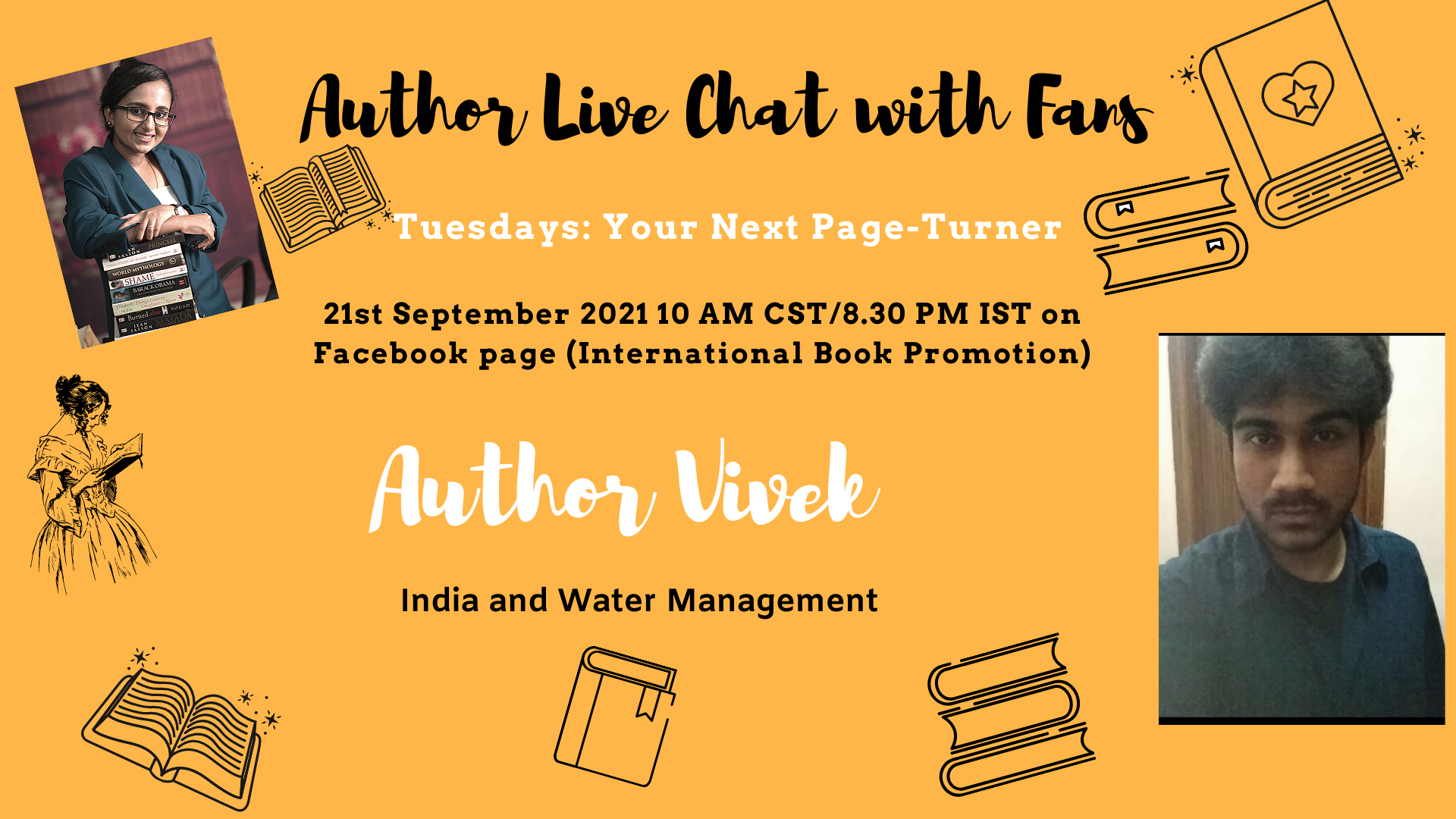
Vivek Balachandran is a computer science graduate from Coimbatore. He has had a few stints in IT, working for firms in Bangalore, Gurgaon, and Mumbai. Inspired by the works of Kovai Kulangal, which has restored the lost channels of the River Noyyal, he became very interested in the subject of water management and started researching the state of water and the way it is managed across India. What started as a research study soon took shape into fiction. He quit his IT career and moved to his hometown to embark on this journey of writing. Against the Flow is his first novel.
Catch the live show
Where are you from?
I am Coimbatore, Tamil Nadu, India.
Why do you write?
This form of expression is detailed and it helps me a paint a picture onto a reader’s mind. So I write for those most valuable one to one’s with the reader
What do you write about?
I write about the issues that surround us and the injustices that have happened in the past. I guess I wouldn’t just stop there but widen my horizon.
Do you have a specific writing style?
Haha, I think I kind of do. I would term my writing as a Notional Faction. Because it combines fact and fiction that are based on true events. My work is mostly research oriented so that the reader gets to learn something new. Also, I try my best to wrap the facts inside a compelling plot.
What are obstacles that come in the way of writing?
Among the many obstacles, the most difficult obstacle is oneself. We are our own boon and bane. During the process we would have to battle so many doubts and inhibitions. At the end of the day, we got to cheer ourselves up, be our own mentor and stay focused.
How long have you been writing?
I used to blog for a while in college but then I dropped it. I guess after 9 years since college I picked it up again.
When did you first realize you wanted to become a writer?
I still don’t exactly remember when I was struck with the realization, but my friends constantly appreciated my writing and it reinforced me with the confidence to write. So, all thanks to my friends, who read my work, appreciated it and encouraged me to write more.
What is your work schedule like when you are writing?
Like I said, my work involves both research and fiction. When I am researching, I am inside the library the moment it opens and I would be the last person to leave. As for writing goes, I would not go more than 600-700 words per day.
How long does it take to write a book?
Well, it took me roughly 1.5 years to research, write and get the book published. But aspiring writers can get it done faster, because I bet you all aren’t a slowpoke like me. But even if it does take time, please be patient because the rewards are something worth treasuring.
Do you have suggestions on how to become a better writer?
This is an art form that has no set rules or protocols. You set the rules and you define the boundaries. But once you do set those, please ensure you stick to them. Often times the temptation and eagerness to write more will get drag you into a loop. So clearly define what you want to write and be consistent.
What challenges do you come across when writing/creating your story?
Apart from doubting ourselves and getting impatient, I think one of the challenges I faced was not knowing how much details I had to reveal to the reader. It was very hard for me to omit most of the research I had done, from the book. But I had to keep it simple, so that the reader doesn’t get bored by too much facts.
What do you think makes a good story?
A good story would be one, that stirs our emotions up pretty intensely. Also, it has got to have an engaging plot that is moderately paced.
Do you see writing as a career?
No, I still do it for my passion. And since this is my first book, I haven’t kept my hopes up high.
Do you have anything specific you’d like to tell the readers?
Please support this form of fiction. Because, it is relevant, real and if it has truly pricked your curiosity, continue to study about these subjects. Because I believe one day, you will make a difference.
How do you work through self-doubts and fear? Having a clear schedule helps. Because it gives you a sense of direction and when you’re facing a writer’s block, take some time off, travel or do something out of your comfort zone.
What writing are you most proud of? There are writers who still firmly believe that the pen is mightier than the sword. I am proud of all those writers, who have conveyed a strong and bitter message, despite the fact that it would invite trouble.
What books did you love growing up?
Fantasy novels mostly. It gives us a free ticket into the realm of writer’s imagination.
Location and life experiences can really influence writing, tell us where you grew up and where you now live?
I was born in Coimbatore, Tamil Nadu. I have worked in Bangalore and Delhi. So all the things I have seen and experienced there have indeed played a major role.
What is hardest – getting published, writing or marketing?
Each has its own share of difficulty. But when you think about publishing, you would have forgotten the difficulties you endured during writing and while marketing you don’t factor the other two. One way to go about it is to not see them as difficulties but a small break to your long journey.
Is there anyone you’d like to acknowledge and thank for their support?
Family and friends aside. There is this one person whom I really want to mention at this moment. This person has been the revolutionary when it comes to water management in India. Her contributions and research have brought so many changes /advancements. I had referred to most of her work for my research. In return, the gift some anti-social elements have given is to try and murder her.
Sunita Narain is that person who youngsters should take up as an inspiration. If you ask me, I would say, it doesn’t matter if you don’t want to read my book. But please do read ‘Excreta Matters’, where she has written in depth about the problems with water management in India.
Every writer has their own idea of what a successful career in writing is, what does success in writing look like to you?
I value appreciation and it is the biggest reward I can get.
It is vital to get exposure and target the right readers for your writing, tell us about your marketing campaign?
I haven’t started on a marketing campaign as such. But my target audience are of the age 18-30. Because it would definitely make them want to learn more about Cyber security and water management. I hope my book acts a gateway to broaden their curiosity into these fields.
Tell us about your new book? Why did you write it?
Few incidents really disturbed me. Injustices were caused, lives were lost, yet nobody cared. I wanted to write about such incidents and the impending problems. The book covers Cyber security issues, water. Management issues and a particular incident that occurred in Tamil Nadu where 13 people lost their lives for raising their voice against environmental hazards.



 International Book Promotion